

Introduction
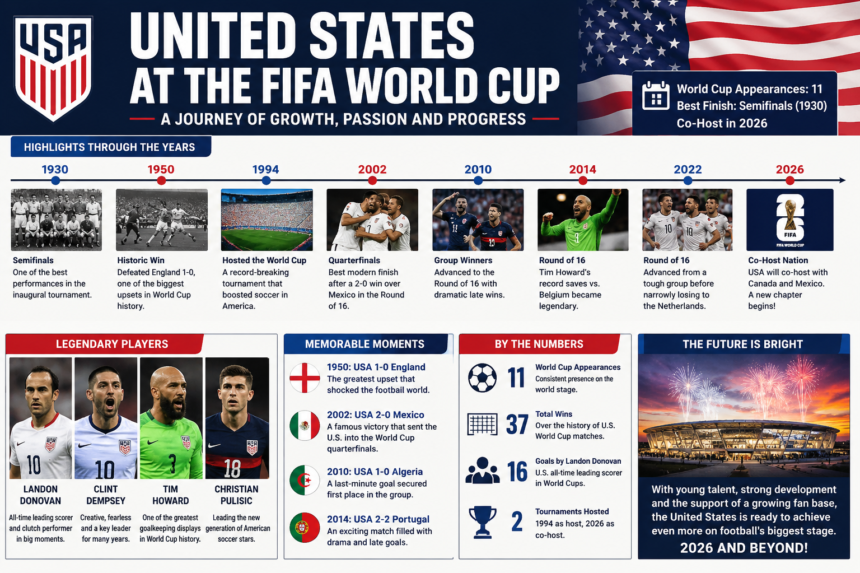
The story of the United States at the FIFA World Cup is one of growth, determination, and increasing success on the international stage. From participating in the inaugural tournament in 1930 to co-hosting the 2026 FIFA World Cup, the United States has become an important part of world football.
Although soccer traditionally competed with other major sports in the country, the popularity of the game has grown significantly over the past few decades. The United States men’s national team (USMNT) has produced memorable World Cup moments and continues to develop as a competitive force.
This article explores the history, achievements, notable players, memorable matches, and future of the United States at the FIFA World Cup.
Early History
The United States was one of the teams that participated in the first FIFA World Cup in 1930, held in Uruguay.
The team made an impressive start by:
- Winning two group-stage matches.
- Reaching the semifinals.
- Finishing among the tournament’s top four teams.
This remains one of the best performances by the United States at the FIFA World Cup.
World Cup Appearances
The United States has qualified for numerous FIFA World Cup tournaments.
Some notable appearances include:
- 1930 – Semifinals.
- 1934 – First Round.
- 1950 – Famous victory over England.
- 1990 – Returned after a long absence.
- 1994 – Hosted the tournament.
- 1998 – Group Stage.
- 2002 – Quarterfinals.
- 2006 – Group Stage.
- 2010 – Round of 16.
- 2014 – Round of 16.
- 2022 – Round of 16.
- 2026 – Co-host nation.
Consistent qualification has helped establish the United States as a regular participant.
The Famous 1950 Victory
One of the greatest moments for the United States at the FIFA World Cup came in 1950.
The Americans defeated England 1-0 in Brazil, one of the biggest upsets in football history.
The winning goal was scored by Joe Gaetjens.
The result remains one of the most celebrated matches in World Cup history.
The Return in 1990
After missing several tournaments, the United States qualified for the 1990 FIFA World Cup.
Although the team did not advance, qualification marked the beginning of a new era for American soccer.
Investment in youth development and professional leagues followed.
Hosting the 1994 FIFA World Cup
The United States hosted the 1994 FIFA World Cup.
The tournament was highly successful and set attendance records.
Benefits included:
- Increased soccer popularity.
- Improved stadium infrastructure.
- Growth of youth soccer.
- Expansion of the fan base.
The event also helped pave the way for the creation of Major League Soccer.
The 2002 Quarterfinal Run
The 2002 FIFA World Cup was one of the best tournaments for the United States.
The team:
- Advanced from the group stage.
- Defeated Mexico in the Round of 16.
- Reached the quarterfinals.
The journey ended with a narrow defeat against Germany.
Many fans consider this the strongest modern performance by the United States at the FIFA World Cup.
Performance in 2010
At the 2010 FIFA World Cup, the United States won its group.
Highlights included:
- A dramatic comeback draw against Slovenia.
- A last-minute victory over Algeria.
- Advancement to the knockout stage.
The team was eliminated by Ghana in extra time.
The 2014 FIFA World Cup
The United States was drawn into a difficult group featuring:
- Germany.
- Portugal.
- Ghana.
Despite the challenge, the Americans reached the Round of 16.
Goalkeeper Tim Howard delivered one of the greatest goalkeeping performances in World Cup history against Belgium.
Missing the 2018 Tournament
The United States failed to qualify for the 2018 FIFA World Cup.
The disappointment led to:
- Coaching changes.
- Youth development reforms.
- Greater investment in player pathways.
Many young players gained international experience after this setback.
The 2022 FIFA World Cup
The United States returned to the World Cup in Qatar.
The team:
- Advanced from the group stage.
- Defeated strong opponents to qualify for the knockout rounds.
- Lost to the Netherlands in the Round of 16.
The tournament showcased a talented young generation.
Hosting the 2026 FIFA World Cup
The United States will co-host the 2026 FIFA World Cup alongside:
- Canada
- Mexico
The tournament will feature an expanded format with more teams and matches.
Hosting offers opportunities to:
- Grow soccer nationwide.
- Improve infrastructure.
- Inspire young players.
- Increase tourism and economic activity.
Greatest Players
Several players have become icons of the United States at the FIFA World Cup.
Landon Donovan
Known for:
- Crucial goals.
- Leadership.
- Historic stoppage-time winner against Algeria.
Clint Dempsey
Recognized for:
- Creativity.
- Goal scoring.
- Strong World Cup performances.
Tim Howard
Famous for:
- Outstanding saves.
- Leadership.
- Record-setting World Cup displays.
Christian Pulisic
One of the leading stars of the modern generation.
Memorable Matches
Some unforgettable World Cup matches include:
United States 1-0 England (1950)
One of football’s greatest upsets.
United States 2-0 Mexico (2002)
A historic knockout-stage victory.
United States 1-0 Algeria (2010)
A dramatic late winner secured first place in the group.
United States 2-2 Portugal (2014)
An exciting match featuring late drama.
Playing Style
The United States has evolved its football philosophy over time.
Modern characteristics include:
- High pressing.
- Quick transitions.
- Athletic players.
- Strong teamwork.
- Tactical flexibility.
Youth academies have improved technical development.
Youth Development
The future of the United States at the FIFA World Cup depends heavily on young talent.
Development pathways include:
- Youth academies.
- College soccer.
- Major League Soccer.
- International club experience.
Many American players now compete in Europe’s top leagues.
Major Challenges
The national team continues to face challenges.
These include:
- Competing with football giants.
- Maintaining consistent performances.
- Developing elite strikers.
- Managing tournament pressure.
Continued investment aims to address these issues.
Records
Some notable achievements include:
- Semifinal appearance in 1930.
- Quarterfinal finish in 2002.
- Multiple Round of 16 appearances.
- Historic 1950 victory over England.
- Hosting the World Cup in 1994 and 2026.
These milestones highlight the nation’s football journey.
Why Soccer Is Growing in America
Several factors have increased soccer’s popularity.
These include:
- Major League Soccer growth.
- International stars.
- Youth participation.
- Television coverage.
- Social media.
- Successful national teams.
The sport continues to attract millions of fans.
Future Expectations
The future looks promising for the United States at the FIFA World Cup.
Strengths include:
- Young talented players.
- Modern training facilities.
- Growing professional leagues.
- Increased international experience.
The 2026 FIFA World Cup presents a major opportunity to achieve new success.
Frequently Asked Questions
How many times has the United States played in the FIFA World Cup?
The United States has participated in numerous World Cup tournaments since 1930.
What is the best World Cup finish?
The team’s best result was reaching the semifinals in 1930.
Has the United States hosted the FIFA World Cup?
Yes, in 1994 and it will co-host the 2026 tournament.
Who is the most famous American World Cup player?
Players such as Landon Donovan, Clint Dempsey, Tim Howard, and Christian Pulisic are among the most recognized.
Final Thoughts
The history of the United States at the FIFA World Cup reflects the growth of soccer in America. From the remarkable semifinal run in 1930 and the famous victory over England in 1950 to the quarterfinal appearance in 2002 and the excitement surrounding the 2026 tournament, the United States has built an increasingly strong football tradition.
With talented young players, expanding domestic leagues, and the opportunity to shine as a co-host of the 2026 FIFA World Cup, the future of the United States at the FIFA World Cup appears brighter than ever.